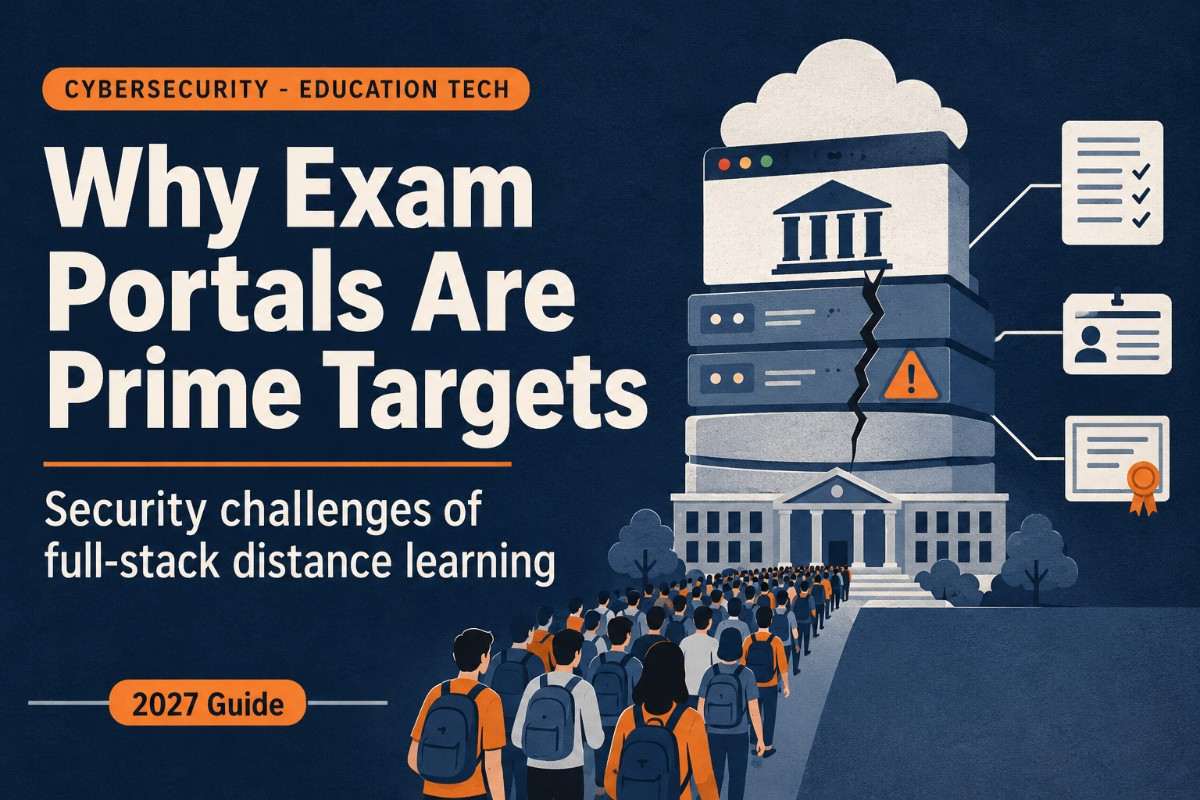
Distance education platforms have grown from repositories of study material into integrated full-stack systems. This guide, based on a 2026 term paper by Manoj Barhpagga (MSc Information Technology, Lovely Professional University), explains why educational platform security is difficult, what is at stake, and how the main threats map to well-known standards.
Key takeaways
- Modern platforms combine web and mobile clients, API gateways, microservices, databases and cloud storage, which widens the attack surface.
- The central tension is between security and performance when thousands of candidates log in within minutes.
- Broken access control, injection and authentication failures map closely onto an examination portal.
- Pressure to weaken controls at peak load is better answered by capacity planning and architecture than by disabling protections.
What is a full-stack educational platform?
A modern platform typically combines browser and mobile clients, API gateways, microservices, relational or document databases and cloud object storage. It supports online examinations, student identity verification, academic analytics and the automated issue of certificates. This gives universities scale and reach, but it also enlarges the attack surface and raises the cost of any failure.
What data do online learning platforms hold?
These platforms hold personally identifiable information (PII), examination content, results, financial records and the credentials on which a student’s career may depend.
Why does peak load create security risk?
The load pattern is unusual. Many learners log in at the same moment during a scheduled examination or result declaration, and controls that are comfortable under normal load can become bottlenecks. Operators are then tempted to relax a control, such as rate limiting or payload encryption, to keep the system available.
This tension between security and performance is the central concern of the study.
Who attacks educational platforms?
- Students seeking to alter grades or impersonate other candidates
- External attackers pursuing identity theft
- Forgers producing fake certificates
Where do the weaknesses occur?
Weaknesses can occur at any layer: the presentation layer (cross-site scripting), the application and API layer (broken access control, injection) and the data layer (exposure of unencrypted records after a database compromise). Because the layers depend on one another, a flaw in one tier can spread to the rest.
Single-page applications add a further risk, since logic running in the browser cannot be trusted and every authorization decision must be enforced on the server.
How does the OWASP Top 10 apply to an exam portal?
The OWASP Top 10 lists broken access control, cryptographic failures, injection and authentication failures among the most serious web risks, and these map closely onto an examination portal.
- Broken access control lets a student read or change another candidate’s record by altering an identifier, known as the insecure direct object reference (IDOR) problem.
- Injection lets an attacker alter queries and therefore marks.
- Authentication failures allow impersonation.
Should you ever disable a control to handle load?
The study recommends testing under realistic peak load with all controls enabled, and never disabling a control to meet a performance target without a documented risk decision.
Note: the study is documentary and analytical. No experiments were run and no performance figures are reported. Standards and laws change, so check current versions before applying any guidance.