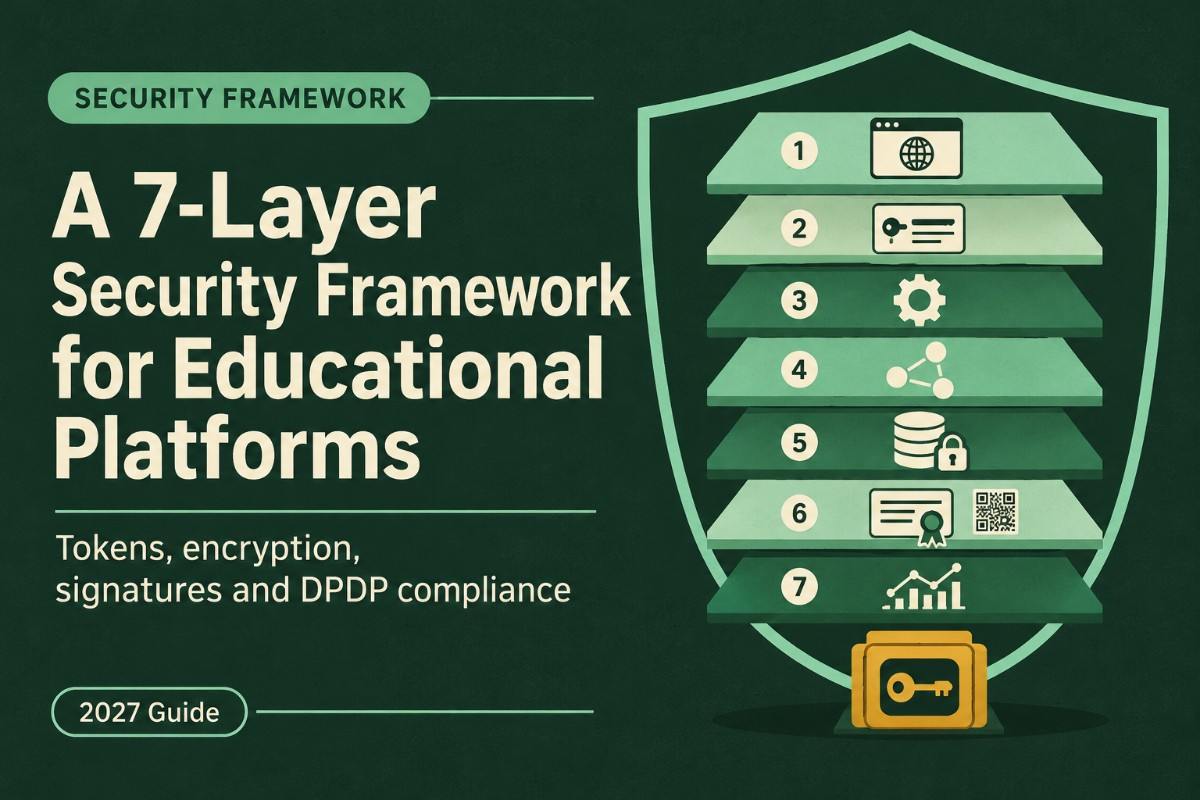
This guide summarises the principal output of a 2026 term paper on data security in full-stack educational platforms: a layered framework that links controls to STRIDE threats, supporting standards and the legal duties of an Indian university.
Key takeaways
- A hybrid token design, envelope-encrypted sensitive fields and HSM-protected signatures resolve most of the apparent conflict between security and performance.
- Authorization is enforced on the server, never in the client.
- Trust is verified at each boundary and not inherited from network position.
- Data is protected so that the loss of any single layer, such as a database snapshot, does not expose it.
Layers 1 and 2: how should presentation, identity and sessions be secured?
The presentation layer uses a content security policy, output encoding and HttpOnly SameSite cookies, and trusts no authorization logic in the client. The identity layer uses OAuth 2.0 with OpenID Connect, short-lived signed tokens, refresh token rotation, a jti deny-list and a risk-based second factor.
How do you combine fast JWT verification with timely revocation?
Short-lived access tokens signed with an asymmetric algorithm can be verified by each microservice using a cached public key, so the common path needs no database access. Refresh tokens, used rarely, are held in HttpOnly SameSite cookies and rotated on use. Where immediate cut-off is needed, such as for a candidate suspected of cheating, a deny-list of jti values in an in-memory store adds one fast lookup at the gateway.
Because the access-token lifetime sets the maximum window of misuse when no revocation check is made, it should be chosen deliberately and not left at a default.
Layers 3 and 4: what do API gateway and Zero Trust controls look like?
The API layer enforces server-side RBAC/ABAC on every request, object-level authorization, parameterized queries and rate limiting. Between services, the framework applies Zero Trust: mutual TLS, per-service identity, segmentation and tenant claim validation at each hop. Client-server transport should use TLS 1.3.
For multi-tenant platforms, PostgreSQL row-level security can force every query to be filtered by tenant. The tenant identity must come from a verified token claim and never from client input.
Layer 5: how does field-level encryption protect student data?
Transparent data encryption protects against theft of media or backups, but offers no defence against SQL injection, a compromised application account or a malicious administrator. Application-layer field-level encryption (FLE) closes that gap, so the database stores only ciphertext. The usual choice is AES-256 in Galois/Counter Mode (GCM), which also detects tampering. GCM must never reuse a nonce with the same key.
In envelope encryption, a data encryption key (DEK) encrypts the field and a key encryption key (KEK), held in a key management service or hardware security module, encrypts the DEK. Rotating the KEK then means re-wrapping DEKs rather than re-encrypting all data. Keeping keys in configuration files or environment variables beside the application defeats the purpose of FLE.
Can encrypted fields still be searched?
Encryption removes the ability to filter, sort or aggregate on a field. A blind index, a keyed hash such as HMAC-SHA-256 of the normalized value stored in a separate indexed column, allows exact-match lookup. It leaks equality, so it should be limited to fields that need lookup, use its own key and avoid fields with few possible values.
Layer 6: which digital signature scheme should sign certificates?
A digital signature verifiable with the university’s public key lets an employer confirm authenticity without contacting the university, and a QR code carrying a signed digest or verification link makes the check practical for printed documents. The Digital Signature Standard approves RSA, ECDSA and EdDSA.
- RSA-2048: about 112 bits of security; 256-byte signatures; slow signing, fast verification; broadest support in PDF and Certifying Authority workflows.
- ECDSA P-256: about 128 bits; 64-byte raw signatures; fast signing and verification; needs a unique secret nonce, and a weak one can expose the private key.
- Ed25519: about 128 bits; 64-byte signatures and 32-byte public keys; deterministic, with no random nonce; check PDF tools and Indian Certifying Authority processes before adoption.
The recommended approach is to use a modern elliptic-curve scheme where verifiers and the legal context permit, and RSA-2048 or larger where compatibility requires it. In both cases the signing key belongs in an HSM, and a revocation mechanism should be available. Speed comparisons are qualitative and should be confirmed by measurement.
Layer 7: why do monitoring and governance matter?
Append-only audit logs, SIEM alerting, a breach response plan and periodic access reviews support non-repudiation and detection across all STRIDE categories.
How can security controls stay fast at peak load?
Costs can be managed by placing each control where it is cheapest. Local verification of signed tokens avoids the database load that session tables would create. Modern processors accelerate AES in hardware, so key retrieval, nonce management and extra storage are more likely to matter than the cipher itself. Certificate signing can run asynchronously on a queue of workers, so a surge of requests does not delay the user. The framework also recommends caching unwrapped DEKs in process memory for a short period instead of calling the KMS for each record.
How does the framework map to DPDP, IT Act, GDPR and FERPA?
- GDPR (EU): Article 32 requires appropriate security, including pseudonymisation and encryption, and breach notification. Supporting controls: field-level encryption, access control, audit logging and incident response.
- DPDP Act, 2023 (India): reasonable security safeguards, breach notification and penalties. Supporting controls: encryption, access control, monitoring, a breach response plan and vendor oversight.
- IT Act, 2000 and 2011 rules (India): Section 43A requires reasonable security practices; the DPDP Act provides for that section to be omitted once the relevant provisions commence, so commencement status should be confirmed.
- FERPA (US): governs access to and disclosure of education records and prescribes no technical controls, so it matters as an access governance duty. Supporting controls: RBAC, authorization checks and audit logs.
The mapping shows where technical controls support compliance and is not legal advice.
Where should an institution start?
The study proposes a phased roadmap that addresses the highest risks first:
- Foundations: classify data fields, enforce TLS 1.3, server-side object-level authorization, parameterized queries and central logging.
- Identity: OIDC single sign-on, shorter token lifetimes, refresh rotation, a jti deny-list and a risk-based second factor.
- Data protection: a key management service, FLE on classified fields, blind indexes where needed and write-once audit logs.
- Credentials: HSM-signed certificates, a verification portal and QR codes, and a revocation process.
- Zero Trust and assurance: mutual TLS, segmentation, tenant isolation, and load, penetration and incident exercises.
Limits of the framework
The framework is internally consistent and grounded in recognised standards, but it has not been tested on a running system. The study reports no measurements; it proposes a measurement protocol for further work. Rules implementing the DPDP Act in particular are evolving, so check current versions of standards and law before applying it in 2027.