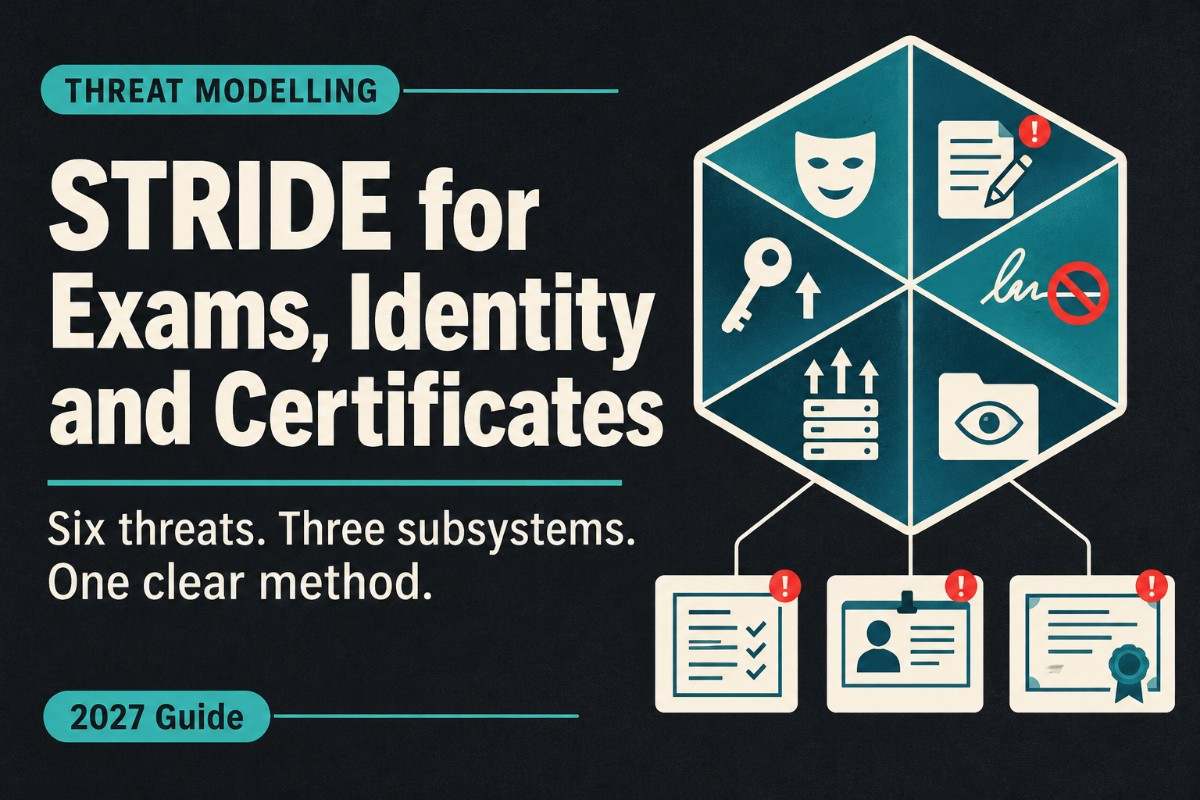
This article summarises the STRIDE analysis from a 2026 term paper on data security in full-stack educational platforms. It shows how one structured method can cover the online examination portal, the student verification dashboard and the automated certificate module.
Key takeaways
- The same STRIDE threat classes recur across exam, verification and certificate functions.
- Highest priorities are those where one failure exposes many records: access control and unencrypted storage.
- Key compromise is less likely but severe, which justifies spending on key custody.
- The analysis is a judgment-based baseline to adapt, not a complete specification.
What is STRIDE threat modelling?
STRIDE groups threats into spoofing, tampering, repudiation, information disclosure, denial of service and elevation of privilege. It is applied by decomposing a system into components and data flows and asking which threat types affect each. It suits educational platforms because the same categories recur across exam, verification and certificate functions.
Which subsystems were analysed?
- Online examination portal: assessment interface, timer synchronization, item bank endpoints and grade recording.
- Student verification dashboard: identity document submission, administrative review and storage of PII.
- Automated certificate module: PDF compilation, hashing, digital signing and QR verification.
Exam portal threats and mitigations
Spoofing and session hijacking. The attack vector is token theft via XSS or interception, by a malicious student or external attacker. Mitigations: short-lived signed tokens, HttpOnly SameSite cookies, TLS 1.3, a content security policy and OIDC federation.
Tampering and grade alteration. The vector is SQL injection on submission endpoints, by a disgruntled student or insider. Mitigations: parameterized queries, strict input validation and integrity checks on stored results.
Denial of service. The vector is request flooding at exam start, by a botnet operator. Mitigations: gateway rate limiting, token-bucket throttling, CDN caching and autoscaling.
Verification dashboard threats and mitigations
Information disclosure. The vector is database query or backup theft exposing PII, by a privileged insider or compromised administrator. Mitigations: field-level AES-256-GCM with KMS-managed keys and least-privilege database roles.
Elevation of privilege and IDOR. The vector is changing object identifiers in API calls, by an unauthorized user or student. Mitigations: server-side RBAC/ABAC on every request and object-level authorization.
Repudiation. The vector is disputed administrative actions by an insider. Mitigations: append-only, time-stamped, signed audit logs in write-once storage.
Certificate module threats and mitigations
Tampering and credential forgery. The vector is modifying award data in a generated PDF, by an external fraudster or diploma mill. Mitigations: a digital signature over the document, QR-based public verification and signing keys held in an HSM.
Which risks should be fixed first?
The study ranks risks using the author’s judgment, not measured incident data, and advises institutions to reassess them in their own context.
- Critical: broken access control (IDOR) on candidate data; exposure of unencrypted PII from a database or backup.
- High: SQL injection on submission endpoints; session or token theft; request flooding at exam start; forged certificates; compromise of signing or encryption keys.
- Medium: tampering with audit logs.
Two patterns emerge. The highest priorities are those where one failure exposes many records: access control and unencrypted storage. Key compromise is less likely but severe, which justifies spending on key custody.
Limits of this analysis
The STRIDE analysis is a judgment-based exercise on generic subsystems. A specific platform may have further components and threats, so the framework should be adapted and validated in the reader’s own environment.